Explore product updates, engineering guides, application insights, and exhibition news from Heymed Medical, covering medical cable assemblies, EEG electrodes, neurostimulation accessories, and OEM/ODM development.
Conductive silicone and Ag/AgCl are both used in ear-worn electrode assemblies, but they are not interchangeable materials. A material that works well for one host device may be the wrong choice for another because the contact mechanism, signal role, clip structure, cleaning method and device-side electrical requirements are different.
For OEM buyers, the useful question is not “Which material is better?” but “Which contact structure matches the device and intended use?” A reliable selection therefore starts with the host system and ends with sample validation under the same defined conditions.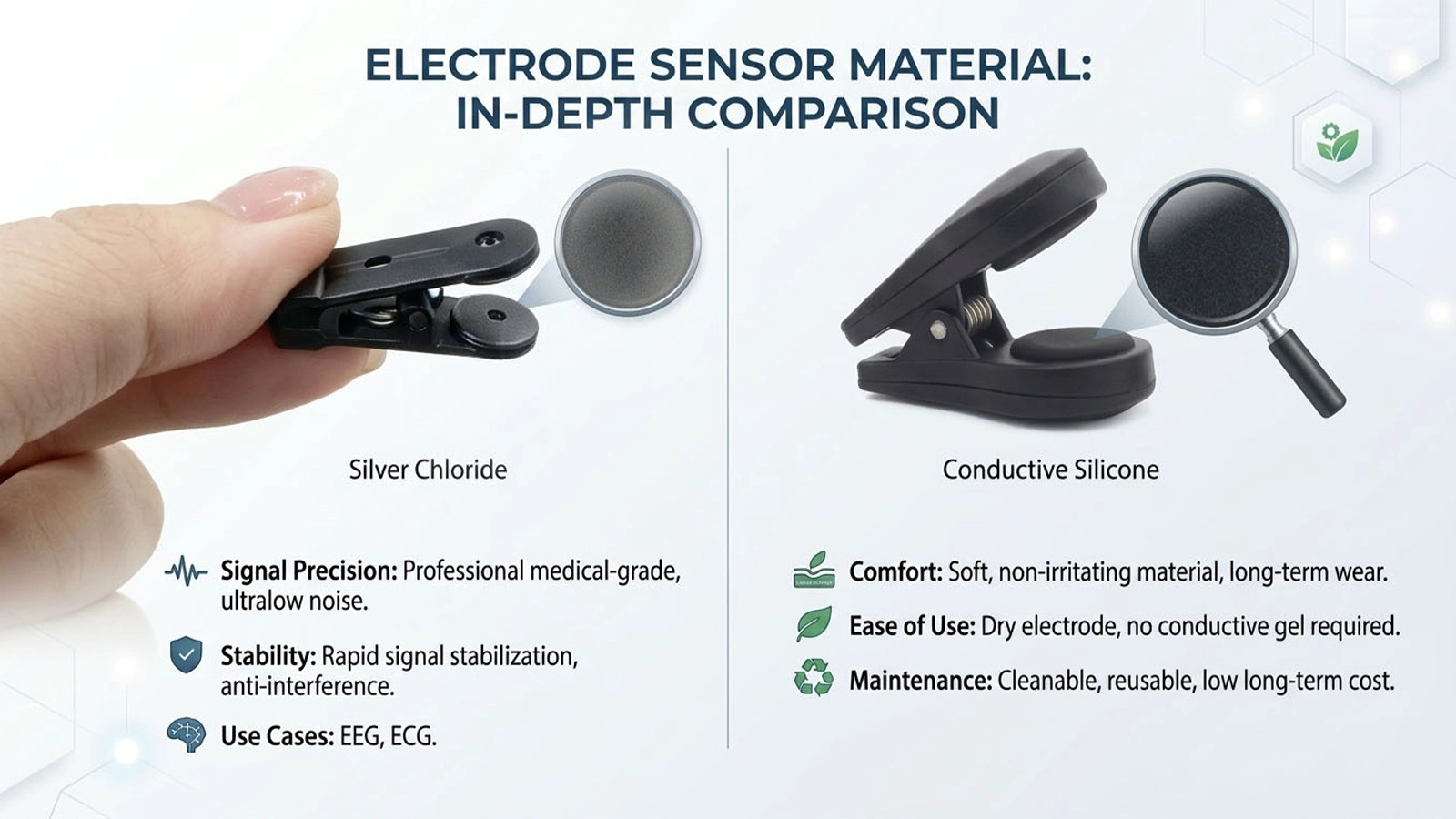
Before choosing conductive silicone or Ag/AgCl, confirm what the ear electrode is expected to do in the host system. Is it being used as a stimulation contact, a sensing or acquisition electrode, a reference/ground connection, or another system-defined interface? The material should follow the electrical and mechanical requirements of that function rather than the appearance of an existing clip.
The project team should also define the intended ear-contact position, number of contacts, single- or bilateral configuration, connector, pinout, cable routing and expected cleaning or reuse conditions. These inputs determine whether the material can be integrated into a practical electrode assembly.
Conductive silicone is a conductive elastomer rather than a metal contact surface. In an ear clip, it can be molded into a flexible contact shape and integrated with the clip body or overmolded structure. This gives engineers more freedom to define the contact geometry, surface area, thickness and mechanical compliance.
Its electrical behavior, however, should not be judged by the word “silicone” alone. Contact resistance and stability depend on the conductive formulation, molded dimensions, contact area, compression, surface cleanliness, cable connection and the host-device circuit. For that reason, an OEM specification should include measurable electrical and mechanical requirements instead of relying only on a material name.
Where a reusable dry-contact concept is required, conductive silicone can be evaluated as one option, but the actual cleaning method, expected reuse cycles and contact performance still need to be verified for the selected formulation and finished structure.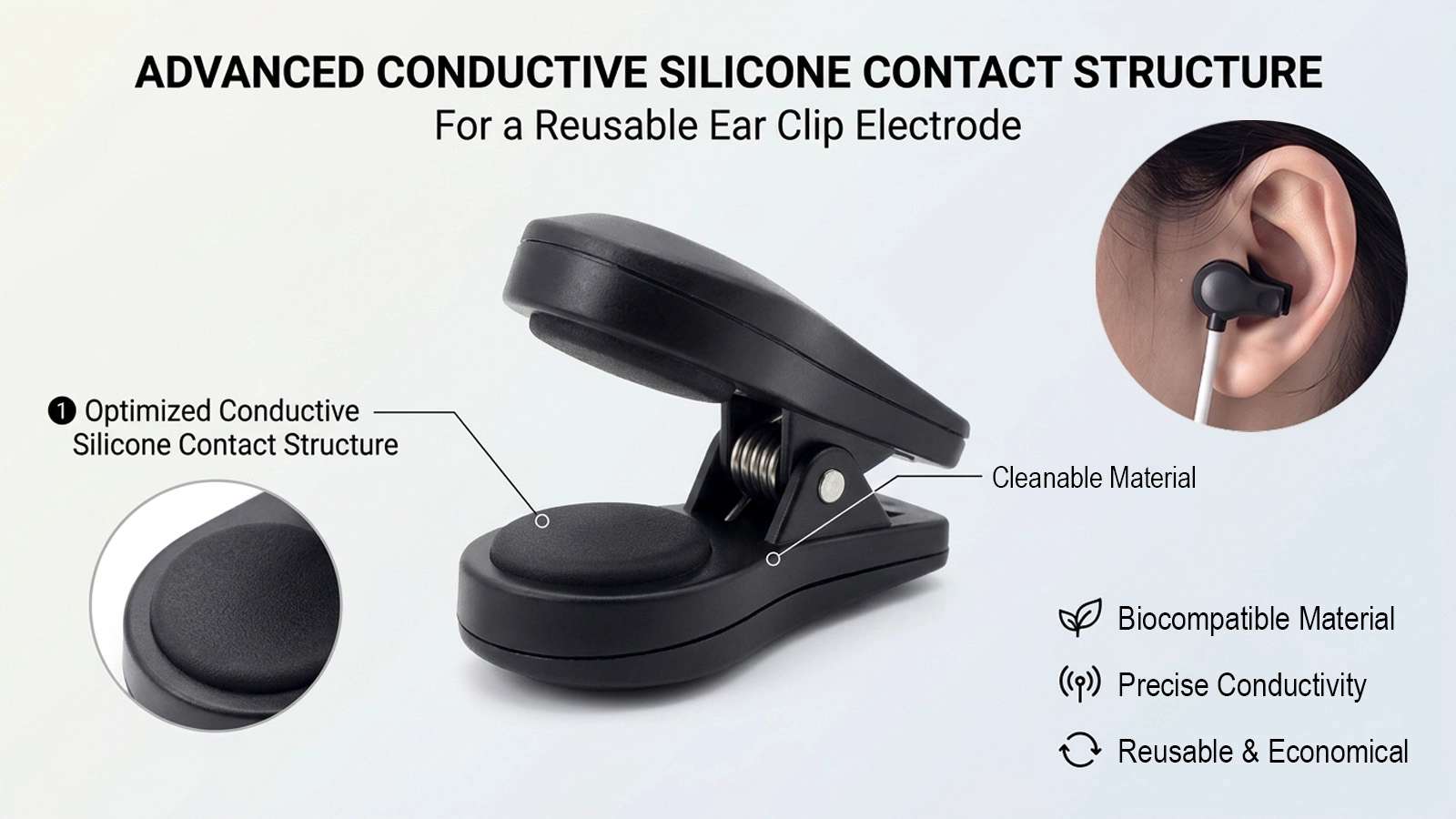
Ag/AgCl combines silver with a silver-chloride interface and is widely used in electrophysiology and biopotential measurement because it can provide a stable electrochemical interface with relatively low polarization. This makes it a common reference point when an acquisition system or device specification calls for Ag/AgCl contact behavior.
That does not mean every Ag/AgCl ear clip will perform the same way. The contact construction, Ag/AgCl preparation, exposed area, supporting clip, surface condition, electrolyte environment where applicable, connector and host-device input circuit all influence the finished assembly.
Some projects use Ag/AgCl in an electrolyte-assisted configuration, while others use a dry contact structure. The correct choice should therefore be based on the actual device specification. A product page or material label should not be used to assume that gel, saline or any specific accessory is always required.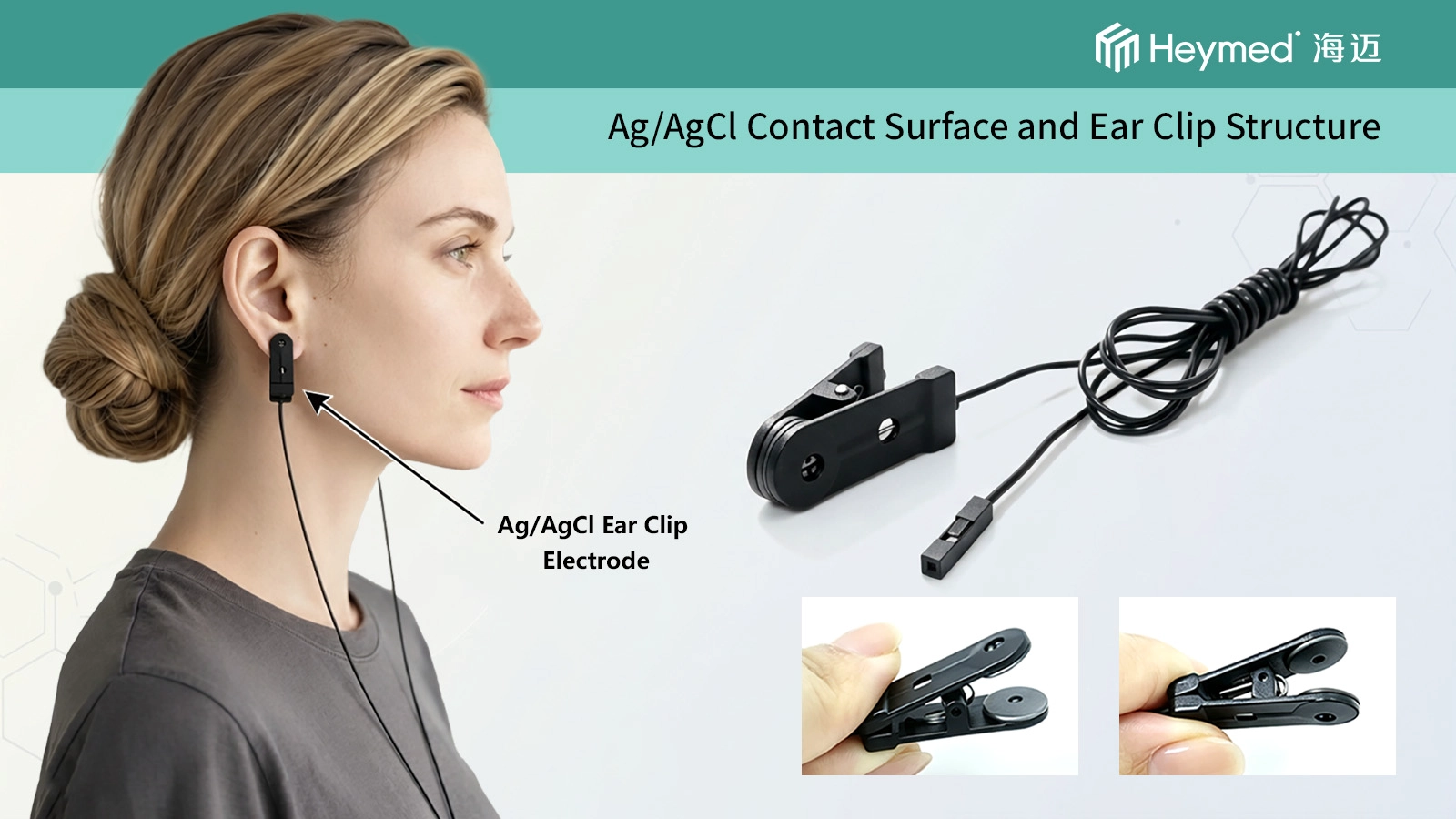
The table is a selection framework, not a ranking. Without data collected on the same host device, contact position, clip force, cable, test method and environmental conditions, Heymed Medical does not recommend making blanket claims that one material has lower impedance, stronger stimulation, better signal quality or longer life than the other.
| Selection factor | Conductive silicone | Ag/AgCl |
|---|---|---|
| Contact form | Conductive composite silicone used as a molded or integrated conductive contact | Silver/silver chloride electrochemical contact surface, typically integrated into a clip or electrode body |
| Mechanical behavior | Can be molded into flexible or compliant shapes; actual feel depends on formulation, dimensions and clip design | The Ag/AgCl contact itself is usually a defined contact surface; overall flexibility depends mainly on the supporting clip structure |
| Interface behavior | Electrical contact depends on material formulation, contact area, compression, surface condition and system design | Ag/AgCl is commonly selected where a stable electrochemical interface and low polarization are important to the measurement or system architecture |
| Dry / wet use | Can be designed as a dry-contact solution where the device and contact geometry permit | May be used in dry or electrolyte-assisted configurations depending on the project; gel or saline should not be assumed unless specified |
| Cleaning / reuse | Reusable designs can be evaluated, but cleaning agents and cycle requirements must be validated for the selected silicone formulation | Cleaning method must be compatible with the Ag/AgCl surface and construction; abrasion and chemical exposure should be controlled |
| Customization | Well suited to molded shapes, contact geometry changes, color and integrated overmold structures | Customization may include contact dimensions, backing structure, clip geometry, connector, cable and assembly method |
| Typical selection driver | Mechanical integration, flexible contact geometry, reusable dry-contact concept or molded structure | Electrochemical interface requirements, biopotential/reference applications, or a host-system specification that calls for Ag/AgCl |
| What still needs validation | Resistance/contact behavior, compression, wear, cleaning, connector/pinout and actual device performance | Contact construction, surface condition, cleaning, connector/pinout and actual device performance under the intended use condition |
A conductive silicone structure is often worth evaluating when the project requires a flexible or molded contact, a compact integrated clip, a reusable dry-contact concept, or a geometry that is difficult to achieve with a rigid contact insert. It can also be useful when the contact needs to follow a curved ear surface or be integrated into an overmolded assembly.
The final decision still depends on the required resistance range, contact pressure, contact area, cleaning method, material documentation and host-device behavior. These should be confirmed in the project specification and first-sample review.
Ag/AgCl is often considered when the host system is designed around a defined electrochemical electrode interface, especially for biopotential acquisition or reference applications. It can also be required when an existing device specification, validated accessory or engineering drawing already identifies Ag/AgCl as the contact material.
The project team should still confirm whether the intended structure is dry or electrolyte-assisted, the contact area, how the Ag/AgCl surface is produced and protected, the cleaning method, the expected number of uses and the mating electrical interface. Material selection alone does not establish compatibility.
Reusable ear electrodes are exposed not only to repeated mechanical opening and closing but also to skin oils, moisture and cleaning agents. These conditions can change the contact surface over time. A cleaning process that is acceptable for one conductive silicone formulation may not be suitable for another, and aggressive abrasion or chemicals may also affect an Ag/AgCl contact surface.
For reusable designs, the project should specify the intended cleaning method, cleaning agent, contact time, expected reuse cycles and post-cleaning acceptance criteria. If those conditions have not been validated, the product description should avoid making an unsupported service-life claim.
A meaningful comparison between conductive silicone and Ag/AgCl requires more than measuring two loose material samples. The comparison should use the same host system, equivalent contact location, defined contact area, controlled clip force, the same cable and connector configuration, and a repeatable test method.
Depending on the project, relevant checks may include continuity, contact resistance, system-level signal behavior, stimulation-output compatibility, connector fit, pull force, repeated opening/closing, cleaning exposure or other device-specific tests. The exact test plan should come from the finished-device requirements.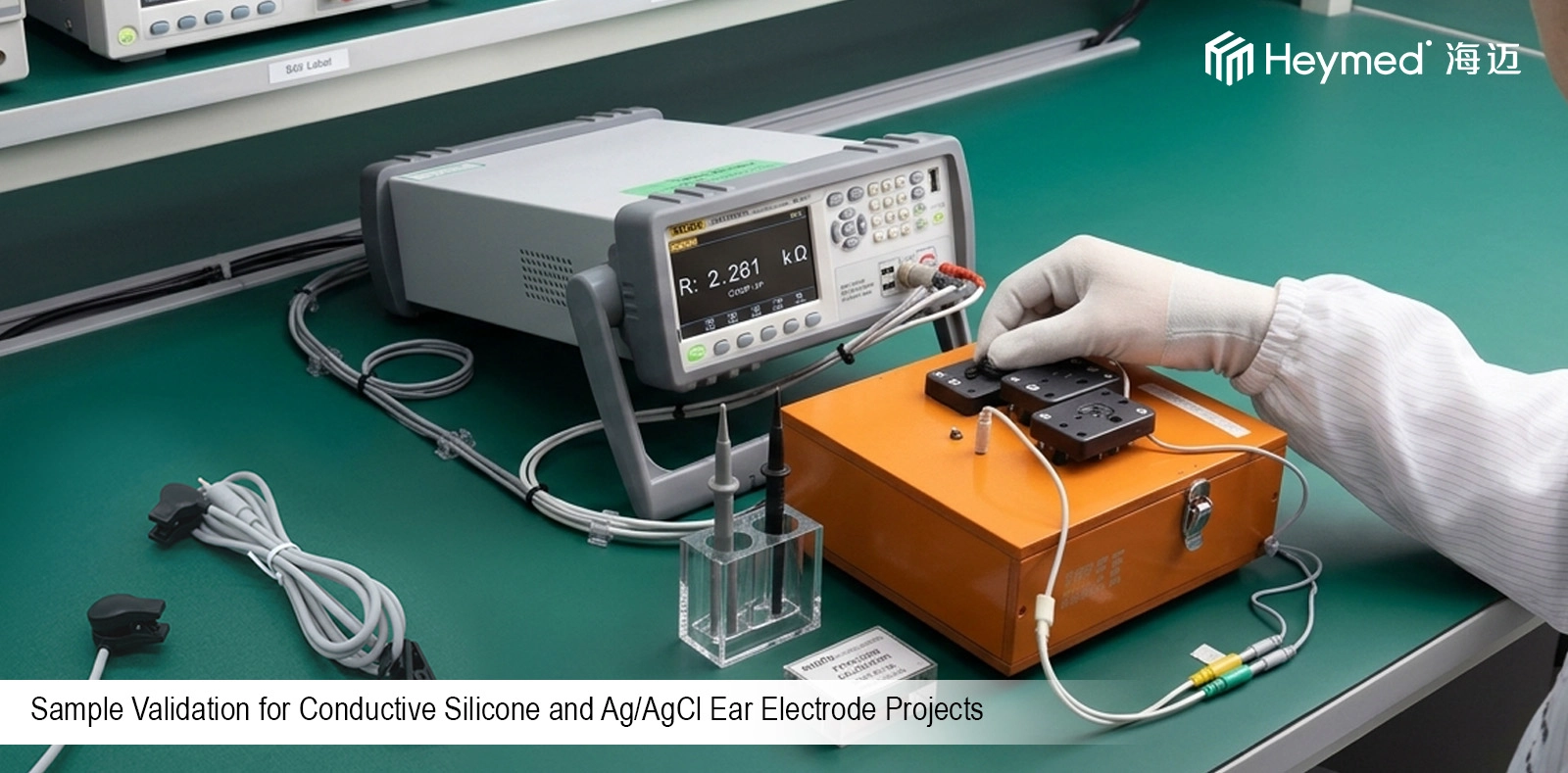
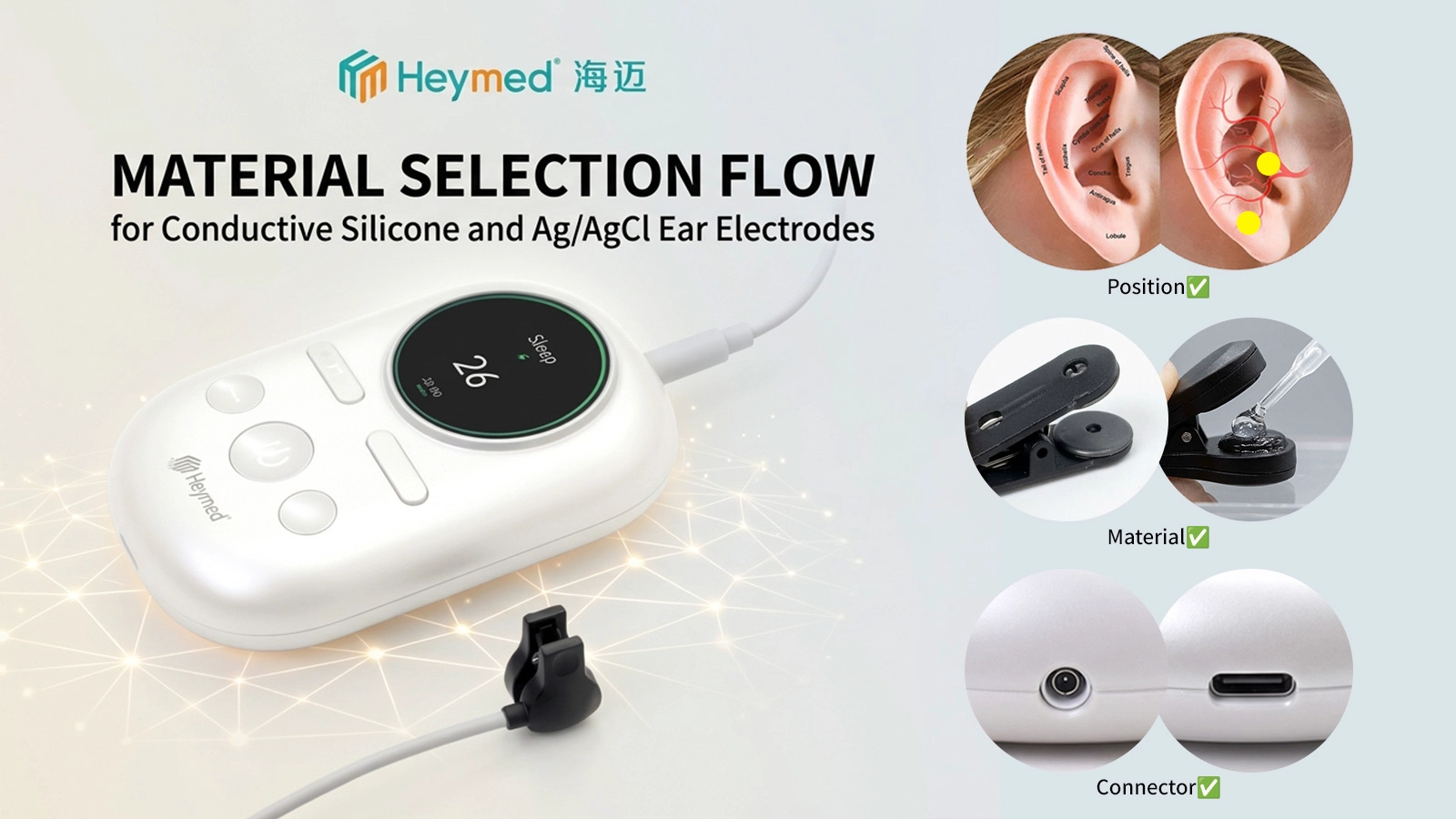
For projects that need a flexible molded contact, Heymed Medical’s conductive silicone ear clip electrode can be used as a structural reference. The connector, cable length, contact geometry and identification can be reviewed for customization according to the host-device requirements.
For projects that specify a silver/silver-chloride interface, the Ag/AgCl ear clip electrode cable can be used as another engineering reference. Compatibility still needs to be confirmed against the device connector, pinout, channel definition and intended contact conditions.
No. The two materials solve different interface problems. Ag/AgCl is commonly selected where its electrochemical behavior is relevant to the host system, while conductive silicone can offer advantages in flexible molded contact structures. The correct choice depends on the finished-device requirements and should be confirmed by testing.
It can be developed as a dry-contact structure when the device architecture, contact geometry and electrical requirements permit. This should be verified on the actual host system rather than assumed from the material name.
No. Ag/AgCl can appear in different electrode constructions. Some systems use electrolyte or gel-assisted contact, while other designs use a dry contact. The product and host-device specification should define the intended interface.
A general answer is not reliable without the same product structure and test conditions. Reuse life depends on material formulation or surface construction, clip mechanics, cleaning, handling and acceptance criteria. If durability is important, define a cycle test and compare samples under the same conditions.
Yes. When the host system does not already require a specific material, producing controlled samples of both options can provide a more useful basis for selection than relying on catalog claims.
Send Heymed Medical your host-device information, intended ear-contact position, connector and pinout, cable requirements, cleaning/reuse conditions and any existing sample. Our engineering team can review the two material routes against the same project requirements before sampling.
Send Your Drawing or SampleWork with Heymed Medical on OEM/ODM development and controlled manufacturing for tVNS and taVNS products, EEG electrodes, medical lead wires, custom cable assemblies, and medical docking and charging products—from engineering samples and validation to volume production.
Tell our engineering team about your product application, device interface, performance targets, compliance needs, and expected quantity. We will review your information and contact you to discuss technical feasibility, customization options, and recommended next steps.
Tip: A drawing, device interface photo, pinout diagram, or reference sample can help our engineering team evaluate your project more accurately and efficiently.
 Search